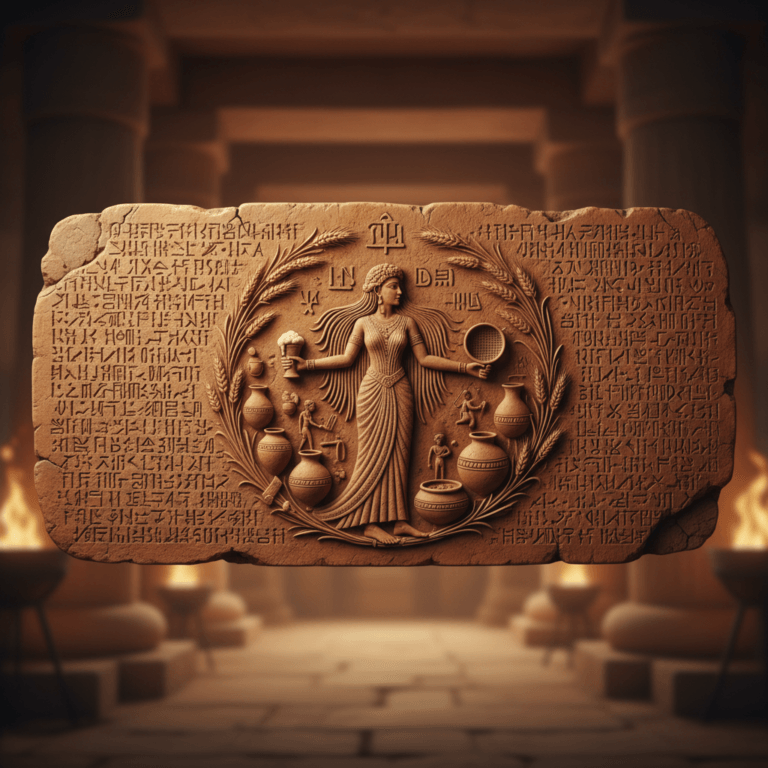

Hymn to Ninkasi: Goddess of Beer and the Myth of the ‘Oldest Beer Recipe’
Estimated Reading Time: 12 minutes
Key Takeaways
- The Hymn to Ninkasi is a fascinating ancient Sumerian poem intertwining beer, mythology, and culture.
- Ninkasi was the Sumerian goddess of beer and fermentation, deeply embedded in daily and religious life.
- While often called the “oldest beer recipe”, the hymn is better understood as a religious poem, not a technical brewing manual.
- The hymn contains real brewing references, but lacks practical brewing details such as precise measurements and process order.
- Modern brewers use the hymn for inspiration, experimenting with ancient ingredients like barley, bappir bread, dates, and honey.
Table of Contents
- Introduction
- Who Was the Ninkasi Goddess?
- The “Oldest Beer Recipe” Debate
- What Was Ancient Sumerian Beer Like?
- The Brewing Process in the Hymn
- Why Ancient Brewing Still Matters
- Conclusion
- Join the Conversation
Introduction
The Hymn to Ninkasi stands as one of the most fascinating texts from ancient Mesopotamia. This Sumerian poem weaves together mythology, religion, and what many have called the world’s oldest beer recipe.
Ninkasi was the Sumerian goddess of beer and fermentation. She held a special place in ancient Mesopotamian culture, where beer was not just a drink but a cornerstone of daily life, religious practice, and social gatherings.
This ancient Sumerian text, written down around 1800 BCE, has captured the imagination of beer lovers and historians for decades. Many have celebrated it as a complete brewing guide passed down from antiquity. But is that really what it is?
In this post, we’ll explore the Hymn to Ninkasi as both a cultural treasure and a debated oldest beer recipe. We’ll examine who Ninkasi was in Sumerian society, what Sumerian beer actually looked like, and whether this ancient poem truly serves as a Mesopotamian beer recipe or something else entirely.
We’ll also look at what modern brewers have done with this ancient beer recipe Sumerian text and why these ancient brewing clues still matter today—for both serious beer historians and adventurous homebrewers.
Who Was the Ninkasi Goddess?
Ninkasi in Sumerian Mythology
Ninkasi was the goddess of beer, fermentation, and abundance in ancient Sumerian belief. According to myth, she brewed fresh beer every single day. Her name literally means “the lady who fills the mouth” in Sumerian—a fitting title for the deity who provided one of life’s most important beverages.
In Sumerian mythology preserved in the hymn, Ninkasi was the daughter of Enki (the god of wisdom and water) and Ninti (a mother goddess). This divine lineage placed her firmly within the pantheon of important deities.
The Ninkasi goddess wasn’t just a minor figure. She represented something essential to Sumerian civilization: the ability to transform simple grain into a nourishing, safe, and socially significant drink.
Beer’s Importance in Ancient Mesopotamia
Understanding Ninkasi’s importance requires understanding how central Sumerian beer was to everyday life in ancient Mesopotamia.
Beer served multiple critical functions:
- Daily nutrition: Beer provided calories, vitamins, and safe hydration when water quality was uncertain
- Religious offerings: Temples offered beer to gods and goddesses during rituals and festivals
- Economic currency: Workers received beer as part of their wages and rations
- Social bonding: Taverns and beer halls served as gathering places for community and celebration
Beer wasn’t a luxury or an indulgence. It was woven into the fabric of Sumerian society at every level. Temple complexes had dedicated brewing facilities. Ration lists carefully recorded beer allocations. Laws regulated beer quality and tavern operations.
In this context, a goddess who presided over brewing held real spiritual and practical significance. Ninkasi’s cult was both spiritually meaningful and practically important to daily survival.
The Hymn Itself
The Hymn to Ninkasi was written down around 1800 BCE during the Old Babylonian period. However, the song itself was likely much older, passed down orally for generations before scribes recorded it on clay tablets.
Tablets containing the hymn were discovered in the Nippur region, an important Sumerian religious and administrative center. The text was written in Sumerian, the language of one of humanity’s first literate civilizations.
The hymn served multiple purposes:
- Praise song: It honored Ninkasi and celebrated her divine role in providing beer
- Drinking song: Evidence suggests it was sung in taverns and during celebrations
- Possible mnemonic: Some scholars believe it helped brewers remember the brewing process through poetic verse
For decades, many popular accounts have described the hymn as the “oldest beer recipe” in the world. This claim has appeared in countless articles, books, and brewery marketing materials. But modern scholarship has begun to seriously question whether that description is accurate.
The “Oldest Beer Recipe” Debate
The Traditional View
For years, the Hymn to Ninkasi has been celebrated as both a religious poem and a functional brewing recipe. This interpretation sees the hymn as cleverly combining worship with practical instruction.
According to this traditional view, the hymn describes:
- Specific ingredients: water, barley, beer bread (bappir), dates, honey
- Distinct steps: baking, soaking, mashing, mixing, fermenting, filtering
- A complete process from grain to finished beer
This interpretation gained widespread popularity after translations in the mid-20th century. The idea that ancient Sumerians encoded brewing knowledge in sacred poetry captured imaginations worldwide. It suggested sophisticated understanding of fermentation long before modern science.
Many articles and books present the hymn as a step-by-step guide that ancient brewers could follow to produce ancient Sumerian beer. Some modern brewers have even claimed to recreate Sumerian beer by following the hymn’s instructions.
The Critical Perspective
Recent scholarship from beer historians and Sumerologists presents a very different picture. These experts argue that the Hymn to Ninkasi is not a usable recipe in any practical sense.
Several serious problems undermine the “recipe” interpretation:
- Fragmentary and unclear text: The clay tablets are incomplete. Translations differ significantly, especially around technical terms. What one scholar translates one way, another interprets completely differently.
- Uncertain terminology: Key words remain poorly understood. Take bappir, often translated as “beer bread.” We know it was important to Sumerian brewing, but we don’t actually know exactly what it was, how it was made, or how it functioned in the brewing process.
- Illogical sequence: When you try to map the hymn’s verses onto actual brewing steps, the order doesn’t make coherent sense. Actions that should happen in a specific sequence for successful brewing appear jumbled or out of order in the poetic text.
- Missing critical details: Essential information any real recipe needs—quantities, temperatures, timing—is completely absent. You cannot successfully brew beer without knowing how much of each ingredient to use or how long each step should take.
As one beer historian bluntly puts it, the hymn is simply not structured as a workable brewing manual. It’s a religious poem that happens to mention brewing imagery and ingredients while praising the goddess.
What the Hymn Actually Is
This blog takes a middle position grounded in current scholarship. The Hymn to Ninkasi should be understood as:
- A religious poem and drinking song first: Its primary purpose was worship and celebration, not instruction. It honored Ninkasi and was likely sung during drinking occasions in taverns and feasts.
- A valuable historical clue: The hymn absolutely provides genuine insights into ancient Sumerian beer production. It mentions real ingredients and actual brewing steps that Sumerians used. It confirms that they understood malting, fermentation, and filtration.
- Not a precise, complete recipe: In the modern sense of a recipe—with measurements, clear procedures, and reproducible results—the hymn falls short. It’s more like a poetic description of brewing than a how-to manual.
Think of it this way: If you read a modern poem celebrating wine-making that mentioned “crushing grapes” and “aging in oak,” you’d learn something about wine production. But you couldn’t actually make wine from that poem alone. The Hymn to Ninkasi is similar—suggestive and informative, but incomplete.
The hymn dates to the Old Babylonian period, around 1800 BCE. It was written in Sumerian and recorded on tablets from Nippur. What makes it remarkable isn’t that it’s a complete recipe, but what it reveals about how deeply embedded beer was in Sumerian culture by that time.
What Was Ancient Sumerian Beer Like?
Ingredients and Characteristics
Ancient Sumerian beer was vastly different from modern beer. Understanding what Sumerians actually drank helps put the hymn in proper context.
Primary ingredients included:
- Barley: The main grain, sometimes supplemented with emmer wheat
- Malt: Germinated and dried grain that provided fermentable sugars
- Bappir: A twice-baked bread or biscuit made from malted grain
- Dates: A common sweetener that added sugars and flavor
- Honey: Another sweetener and flavor enhancer
- Aromatics: Various plants and spices, though we’re not certain which ones
The brewing process, as far as we can reconstruct it from multiple sources (not just the hymn), involved:
- Malting grain by soaking and germinating it, then drying
- Baking bappir bread from malted grain
- Creating a mash by combining bappir, malt, and water
- Allowing natural fermentation to occur
- Filtering the mixture into collection vessels
- Consuming relatively quickly, as the beer didn’t keep long
Comparing Ancient and Modern Beer
Mesopotamian beer recipe approaches resulted in a beverage nothing like today’s commercial beer.
Key differences:
- Texture: Sumerian beer was likely thick and cloudy, almost porridge-like. It contained substantial sediment and grain particles. Modern beer is typically clear and liquid.
- Carbonation: Ancient beer had little to no carbonation. It was drunk young, before much CO2 could develop. Modern beer is usually carbonated.
- Serving method: Sumerians often drank beer through straws from communal jars. This kept drinkers from consuming the sediment that settled at the bottom. Today we pour beer into individual glasses.
- Flavor profile: Ancient beer tasted of grain, dates, and honey rather than hops. It was sweet, bread-like, and complex. Modern beer usually features hop bitterness and cleaner grain flavors.
- Strength: Ancient beer came in various strengths, from weak “workers’ beer” to stronger “festival beer.” Alcohol content varied widely based on grain and sugar content.
- Freshness: Sumerian beer was consumed very young, often within days of brewing. It didn’t have preservatives and wouldn’t keep long in the hot climate.
Beer’s Social and Religious Roles
Beer in Sumerian society served purposes far beyond simple refreshment.
Religious functions:
- Temples brewed beer for offerings to gods and goddesses
- Beer featured prominently in festivals and religious celebrations
- Priests and priestesses received beer rations
- The goddess Ninkasi herself received beer offerings
Social contexts:
- Taverns served as community gathering places
- Beer featured in celebrations, weddings, and funerals
- Drinking songs (possibly including the Hymn to Ninkasi) were sung in groups
- Sharing beer built social bonds and hospitality
Economic importance:
- Workers received daily beer rations as part of their pay
- Beer quality and quantity were strictly regulated by law
- Temple complexes controlled large-scale brewing operations
- Beer represented stored grain value and could function like currency
The Hymn to Ninkasi makes more sense when you understand this context. It wasn’t just about the technical process of brewing. It was about honoring the divine force behind something that touched every aspect of Sumerian life—from temple ritual to tavern singing to daily wages.
The Brewing Process in the Hymn
Key Brewing-Related Verses
Despite its limitations as a precise ancient beer recipe Sumerian manual, the hymn does reference specific brewing actions and ingredients.
Paraphrasing key passages:
- Baking bappir: The hymn describes Ninkasi handling dough and baking the special bread. This bappir was crucial to Sumerian brewing, though exactly how it was made and used remains debated.
- Soaking malt: The goddess soaks malt in a jar, beginning the process of extracting sugars. This mirrors the mashing process in modern brewing.
- Cooling mash: Cooked mash is spread on reed mats to cool. This practical step prevents overheating that would kill fermentation organisms.
- Mixing ingredients: The hymn mentions combining bappir with “sweet aromatics,” honey, and dates. These additions would provide extra sugars, flavors, and possibly help fermentation.
- Moving the wort: Sweet wort (the sugar-rich liquid before fermentation) is transferred to vessels. The hymn poetically describes this as Ninkasi working with honey and wine.
- Filtering: The final beer is filtered into a collector vat, separating liquid from solids. This produced a clearer (though still cloudy by modern standards) finished product.
These steps do reflect real brewing processes. They show that Sumerians understood the fundamentals of beer-making: converting grain starches to sugar, fermenting those sugars to alcohol, and separating the liquid beer from grain solids.
Scholarly Disputes and Translation Issues
The problem comes when you try to use these verses as actual brewing instructions.
Translation variations: Different scholars translate key passages differently. For example, early translator Miguel Civil interpreted certain lines one way, while later reassessments have suggested different readings. These aren’t minor differences—they can completely change what we think a verse is describing.
Contradictions with other sources: Other Sumerian texts about beer and rations sometimes describe brewing processes that don’t quite match what the hymn seems to say. This suggests the hymn isn’t a technical document but a poetic interpretation.
Missing technical details: The hymn never tells you:
- How much bappir to use
- What ratio of malt to water
- How much dates or honey to add
- How long to ferment
- What temperature to maintain
- How to tell when beer is ready
Without these details, even the most experienced brewer would struggle to produce consistent results.
Unclear sequence: Some actions in the hymn don’t appear in the logical order you’d need for successful brewing. This makes sense if it’s poetry following artistic rather than technical logic, but it makes the hymn unusable as a step-by-step guide.
The Ninkasi beer poem gives us a poetic glimpse of brewing, not a workshop manual.
Inspiration for Modern Homebrewers
Despite not being a usable recipe, the hymn can still inspire modern brewing experiments. The key is approaching it as inspiration rather than instruction.
Experimental brewing tips:
- Use a barley-based grain bill as your foundation, just as Sumerians did. Barley remains excellent for brewing because of its husk structure and enzyme content.
- Include a baked bread or biscuit component. Some modern brewers bake simple barley-malt bread, toast it, and add it to the mash. This echoes the bappir mentioned in the hymn.
- Add dates or honey for sweetness and complexity. Start with small amounts—perhaps 1-2 pounds of dates or 1 pound of honey for a 5-gallon batch—and adjust to taste in future batches.
- Skip the hops or use them very sparingly. Ancient Sumerian beer predated hop usage. If you want some bitterness or preservation, consider alternative bittering agents used in ancient brewing.
- Aim for a cloudy, full-bodied beer. Don’t over-filter. A hazy, grain-forward beer better matches what Sumerians would have produced.
- Use cooling and filtration methods that echo the hymn. Spread hot mash to cool it, and use simple grain-bed filtration rather than modern equipment.
Famous modern recreations: In 1989, Anchor Brewing collaborated with scholars to create a “Ninkasi” beer based on the hymn. The result was described as having “the smoothness and effervescence of champagne and a slight aroma of dates.” This recreation inspired many homebrewers to try their own versions.
Variations in Modern Interpretations
Because the hymn leaves so much open to interpretation, modern brewers have created widely varying “Ninkasi beers.”
Different approaches include:
- Yeast selection: Some use modern ale yeast, others try wild fermentation to mimic ancient conditions, and some even attempt to culture yeast from dates or grain.
- Bread types: Bappir interpretations range from simple toasted barley bread to elaborate twice-baked biscuits with honey and spices.
- Sweetness levels: Date and honey additions vary from minimal to substantial, producing beers ranging from dry and grain-forward to sweet and dessert-like.
- Fermentation approach: Temperature control, vessel type, and fermentation length all vary based on brewer interpretation and available evidence.
These variations reflect the gaps in our knowledge. We simply don’t have enough information to create one “authentic” Sumerian beer. Instead, we have a range of experiments, all inspired by the same ancient source but producing different results.
That’s not a failure—it’s an opportunity for creativity and experimentation within historical constraints.
Why Ancient Brewing Still Matters
Understanding Past Cultures Through Beer
Ancient beer recipes and texts like the Hymn to Ninkasi offer unique windows into vanished civilizations.
Beer reveals the intersection of multiple aspects of ancient life:
- Technology: Brewing required understanding of malting, fermentation, temperature control, and storage. The sophistication of Sumerian brewing shows they had advanced practical knowledge long before scientific explanations existed.
- Agriculture: Beer drove grain cultivation. Surplus grain production enabled cities, specialized labor, and civilization itself. Understanding ancient beer helps us understand the agricultural foundations of early societies.
- Religion: Beer’s presence in offerings, festivals, and mythology reveals spiritual values. The fact that beer had its own goddess shows how central it was to Sumerian religious life.
- Daily life: Beer rations, tavern culture, and social drinking reveal how ordinary people lived, worked, and relaxed. These details often get lost in histories focused on kings and temples.
- Economic systems: Beer as wages, temple production, regulated quality—all show how ancient economies functioned at practical levels.
The Hymn to Ninkasi connects all these threads. It’s religious poetry that references technological processes used in agricultural production that sustained daily life and economic systems.
Practical Benefits for Modern Brewing
Ancient brewing knowledge offers concrete benefits for today’s homebrewers and craft brewers.
- Ingredient experimentation: Ancient recipes encourage use of:
- Alternative grains beyond standard brewing barley
- Bread and baked goods in the mash
- Unusual sweeteners like dates, honey, and fruit
- Herbs and spices instead of or alongside hops
- Process innovation: Ancient methods inspire:
- Mixed fermentation approaches
- Alternative cooling and temperature control
- Simple, low-tech equipment that still produces good results
- Quick-turnaround beers that don’t require long aging
- Flavor exploration: Ancient beer styles open up:
- Bread-forward, grainy flavor profiles
- Sweetness from natural sources rather than added sugars
- Complex flavor from ingredient combinations rather than single-note clarity
- Unfiltered, full-bodied textures
Modern craft brewing has seen explosive growth in experimental styles. Many successful brewers credit historical and archaeological brewing with inspiring innovative approaches that set them apart in a crowded market.
The Historical Brewing Movement
The Hymn to Ninkasi sits within a broader movement of historically-inspired and archaeologically-informed brewing.
This movement involves:
- Academic research: Historians and archaeologists study ancient texts, residue analysis from pottery, and agricultural evidence to understand what and how ancient peoples brewed.
- Collaborative experiments: Researchers partner with breweries to test hypotheses about ancient brewing. These collaborations produce both scholarly insights and actual beer.
- Public engagement: Museums, historical sites, and breweries create educational programs around ancient beer, making history tangible and tasty.
- Preservation of techniques: Some brewers work to preserve and revive traditional brewing methods before they disappear entirely.
Examples beyond the Hymn to Ninkasi include recreations of Egyptian beer, Viking mead, colonial American ales, and medieval monastery brews. Each project combines scholarly research with practical brewing experimentation.
These efforts matter because they:
- Preserve knowledge and techniques that might otherwise be lost
- Make history accessible and engaging to general audiences
- Generate new research questions and scholarly insights
- Create connections between past and present
- Celebrate cultural heritage through living tradition
The Hymn to Ninkasi inspired one of the earliest modern attempts at archaeological brewing. Its ongoing influence continues to spark new experiments and research.
Conclusion
The Hymn to Ninkasi remains one of the most captivating texts from ancient Mesopotamia. This Sumerian poem offers a vivid glimpse into a culture where beer was divine, essential, and everywhere.
For decades, the hymn has been celebrated as the “oldest beer recipe” in the world. That claim captured imaginations and inspired countless brewing experiments. But modern scholarship shows a more nuanced reality.
The hymn is better understood as a religious poem and drinking song—a piece of worship and celebration rather than a technical manual. It provides genuine clues about ancient Sumerian beer production, confirming that Sumerians understood malting, fermentation, and filtration thousands of years ago.
But it’s not a precise, complete recipe in the modern sense. The fragmentary text, uncertain translations, missing measurements, and unclear sequences prevent it from functioning as a workable brewing guide.
That doesn’t diminish the hymn’s value. If anything, understanding it more accurately increases our appreciation. It shows us how deeply beer was woven into Sumerian culture—important enough to have its own goddess, featured in sacred poetry, sung in taverns and temples alike.
For beer historians, the hymn offers rich material for understanding ancient technology, agriculture, religion, and daily life. For adventurous homebrewers, it provides inspiration for experimentation with ancient grains, baking bread for the mash, adding dates and honey, and exploring pre-hop brewing traditions.
The Hymn to Ninkasi invites us to engage with history hands-on. Even if we can’t recreate authentic Sumerian beer, we can brew beers inspired by their ingredients and methods. We can taste something that connects us, however imperfectly, to brewers from 4,000 years ago.
That connection—between ancient and modern, scholarly and practical, sacred and everyday—is what makes the hymn so enduringly fascinating.
Join the Conversation
Have you tried brewing a Ninkasi-inspired beer? We’d love to hear about your experience.
Share your experiments in the comments:
- What ingredients did you use?
- How did you interpret the hymn’s brewing descriptions?
- How did your ancient-style beer turn out?
- What would you do differently next time?
Even if you haven’t brewed ancient-inspired beer yet, join the discussion:
- What aspects of Sumerian brewing interest you most?
- Do you have questions about the hymn or ancient brewing techniques?
- What other historical beer styles would you like to learn about?
Resources for deeper exploration:
Read accessible translations of the Hymn to Ninkasi:
– World History Encyclopedia
– Electronic Text Corpus of Sumerian Literature
Learn more about the recipe debate and Sumerian brewing:
– Zythophile Blog
– Beer Connoisseur Article
Explore modern recreations and experiments:
– One Mind Brewing
Connect with communities interested in historical brewing:
Look for online forums and groups focused on:
- Archaeological and historical brewing
- Experimental homebrewing
- Ancient food and drink recreation
- Mesopotamian history and culture
Many homebrewing forums have sections dedicated to historical styles and experimental brewing. Sharing your attempts, failures, and successes helps build collective knowledge about these ancient traditions.
Whether you’re a serious beer historian or a curious homebrewer looking for your next adventurous batch, the Hymn to Ninkasi offers endless fascination. It connects us to our ancestors through something they considered divine—the simple, profound pleasure of a well-made beer.
Raise a glass to Ninkasi, the goddess who still inspires brewers 4,000 years later.